
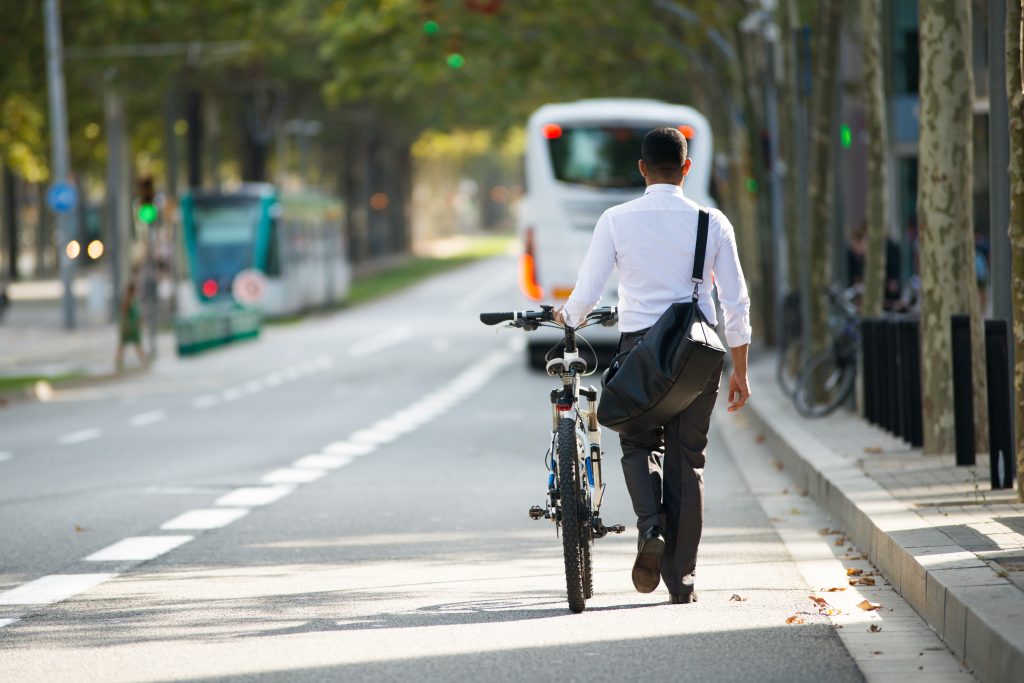
The main sustainable alternatives for commuting to work are public transport, active travel (cycling or walking), remote working where the role allows it, low-emission vehicles and car-sharing. The right choice depends on the distance, working hours (fixed or rotating shifts) and the area’s public transport coverage: there is no single alternative that works for every journey.
In this guide, Waiis takes a look at each option, including its practical benefits and limitations, to help you decide which sustainable transport alternative is best for you.
What counts as a sustainable way to get to work?
A sustainable commuting alternative is any way of travelling to work that reduces the environmental impact and congestion associated with individual use of a private combustion-engine vehicle. Sustainable or low-impact mobility includes travelling without a vehicle (on foot or by bike), several people sharing a journey (on public transport or in a car-share), using a low-emission vehicle, or eliminating the journey altogether (through remote working). There is no one-size-fits-all solution, but a range of options that can be combined depending on the journey, working hours and each employee’s personal circumstances.
Public transport
Public transport (urban and interurban buses, the underground and commuter trains) remains the leading sustainable travel option, particularly where there is a good network of routes and reasonable frequencies at the start and end of the working day. Its benefits are clear: predictable, stable costs (monthly travel passes), no need to park, and the chance to make use of the journey for other things.
Its main limitation arises on journeys that involve changing between several modes, in areas with poor route coverage, or outside normal service hours: night shifts, early mornings and weekends, when services become much less frequent or disappear altogether.
Active travel: cycling and walking
For short journeys, active travel is the most sustainable option and often the quickest too in congested urban areas. For it to be a realistic option rather than a token gesture, employers need to provide basic facilities such as secure cycle parking, changing rooms or showers. Its limitations are clear: distance, terrain, weather and the need to arrive at work in a fit state to do the job. It is not a universal alternative; it is best suited to people who live relatively close to work.
Remote working (and its limits)
When the role allows it, remote working eliminates the commute altogether and is, in that sense, the lowest-impact option of all. However, it cannot replace the other options for two reasons: first, not every job can be done remotely (production, in-person customer service, logistics, healthcare, and so on); and second, even in roles that can be done remotely, employees usually still have to attend the workplace on some days, so the physical journey still needs to be addressed.
Remote working works best as a way to reduce how often the mobility problem arises, not as a solution that removes it completely.
Low-emission vehicles
Switching from a private car to a low-emission vehicle (an electric car or plug-in hybrid) reduces the environmental impact of the journey without changing the habit of travelling alone by car. This can be a relevant option when the employer provides charging points at the workplace or parking incentives, and when other alternatives (public transport, cycling or car-sharing) are not viable for that particular journey because of the distance or working hours. Its main limitation is the purchase price of the vehicle, which remains higher than that of an equivalent combustion-engine vehicle.
Car-sharing: the best alternative with Waiis
Car-sharing is the alternative that works best where the other options fall short: remote industrial estates, night or rotating shifts without public transport, and journeys from residential areas with poor connections. Unlike buses or trains, it does not depend on fixed routes or timetables; unlike cycling or walking, it removes the barriers of distance and weather.
Historically, the main barrier to carpooling was the manual organisation involved: finding colleagues with identical routines, coordinating schedules every day and managing payments. Waiis removes those obstacles, turning car-sharing into an automated, affordable and safe solution:
- AI-powered smart matching: Set your usual origin, destination and timetable once. Waiis’s Smart Match technology automatically identifies compatible routes within your company or community, connecting you with other users without the need to search actively.
- Energy savings rewards: Drivers do not just share fuel costs; they can also receive up to €0.07/km (provided the journey meets the conditions) through the Energy Saving Certificates (CAE) scheme, turning their daily commute into extra income.
- Guaranteed arrival: If there is no match available at your usual time on a particular day, Waiis lets you book a taxi or private-hire vehicle at a fixed price through the app itself. You are never left stranded.
- End-to-end support for businesses (PMST): If your workplace wants to comply with the 2026 Sustainable Mobility Act, Waiis automates employee mobility assessments, measures avoided CO₂ emissions and generates ESG reports for the Sustainable Mobility to Work Plan (PMST).
Waiis turns everyday commutes into an efficient routine that saves money, removes the stress of driving and actively contributes to cleaner urban mobility.
You might also be interested in

Is car sharing with Waiis safe?
Find out how safety works at Waiis: identity verification with Tecalis, driving-licence checks, a women-only option and real-time tracking.

Sustainable Mobility to Work Plan (PMST): what it is, who needs one and how to implement it
Find out what a Sustainable Mobility to Work Plan (PMST) is, which workplaces must have one, what it should include and how to implement it before 5 December 2026.