
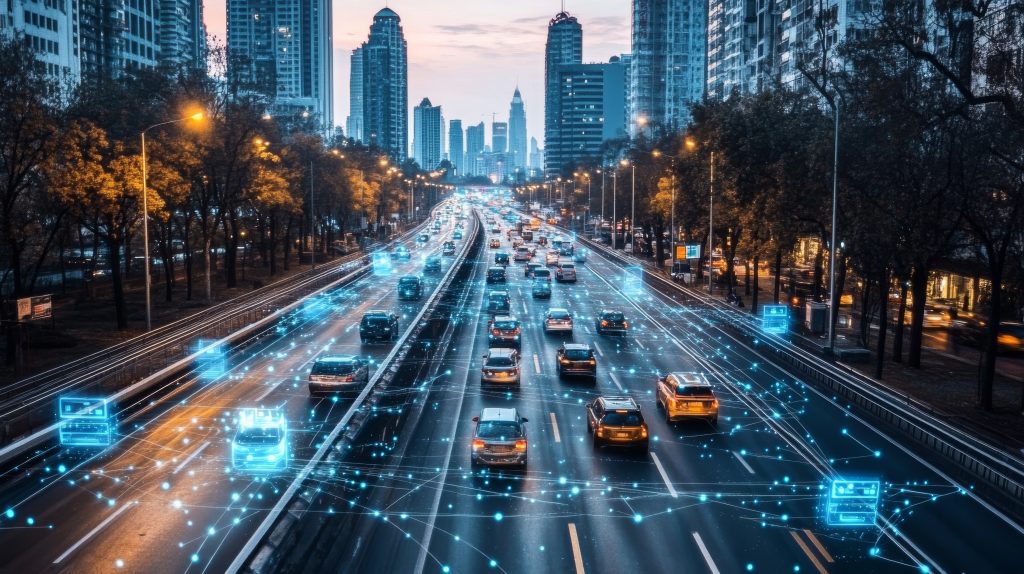
As cities and companies look for more efficient ways to manage travel, AI offers tools to make information-based decisions. However, its results depend on the quality of the data, how the technology is integrated into existing services and people’s real needs.
At WAIIS, we apply artificial intelligence to a specific challenge: making carpooling easier by connecting people with compatible journeys and schedules. This is one of the areas where artificial intelligence and mobility pattern analysis can help simplify everyday travel.
What are the applications of artificial intelligence in mobility?
Artificial intelligence can be used at different stages of mobility: from anticipating how many people will need to travel to identifying disruptions, optimizing resources or finding matches between routes. These are some of its main applications.
1. Predicting demand and planning transport
Artificial intelligence systems can analyze historical travel data and link it to factors such as times of day, days of the week, events or weather conditions. Based on that information, they can estimate how transport demand might change.
These forecasts help operators and public authorities identify where more resources are needed, which time slots have the most trips and how to adapt planning to mobility patterns. For example, a transport company can use past demand data to anticipate higher passenger numbers during an event.
The usefulness of these tools doesn’t depend solely on the accuracy of the model. Forecasts also need to translate into sound operational decisions and services that meet users’ needs.
2. Improving traffic management and detecting incidents
Artificial intelligence can also help analyze traffic flows, identify congestion patterns and detect anomalies in traffic data. By combining information from sensors, cameras, transport systems and other available sources, certain tools can help anticipate problems and coordinate urban mobility.
For example, traffic management systems can use up-to-date information to identify a congested road and assess alternative routes. They can also support the analysis of incidents affecting buses, private vehicles or connections between different modes of transport.
However, improving traffic doesn’t necessarily mean prioritizing cars. Efficient management must also consider public transport, walking, cycling and accessibility needs. The goal is to use data to make decisions that improve how the mobility system works as a whole.
3. Optimizing public transport and multimodal mobility
Artificial intelligence can help plan public transport services, analyze demand and coordinate different travel options. Combined with digital platforms, it can help provide more useful information on timetables, connections and routes. It can also support the planning of services tailored to the needs of each area.
This approach is linked to multimodal mobility, which involves combining different modes of transport to complete a journey. A single trip might include, for example, a train ride, a bus and a walk.
Artificial intelligence can help analyze these combinations and spot opportunities to improve connections. However, the usefulness of its recommendations depends on the information being up to date and the services actually being available. In industrial areas or workplaces far from the main public transport corridors, these solutions can be complemented by other alternatives, such as carpooling.
4. Anticipating breakdowns through predictive maintenance
Predictive maintenance uses data on how vehicles, equipment and infrastructure are performing to detect signs that could indicate a failure. Artificial intelligence models can analyze patterns in vibration, temperature, wear or other variables to identify unusual behavior and help prioritize inspections.
In mobility, these tools can be applied to vehicle fleets, rail systems, signaling equipment and certain transport infrastructure. For example, analyzing a vehicle’s operating data can help detect signs of a possible breakdown before it disrupts the service.
AI doesn’t replace inspections or guarantee that every fault will be detected. Its role is to provide additional information so that maintenance managers can assess alerts and make better-informed decisions.
5. Connecting compatible journeys through carpooling
Carpooling is another application of artificial intelligence in mobility, especially relevant for daily commutes. To organize a shared trip, it isn’t enough to find two people heading to the same city: you also need to check whether their routes, schedules and pick-up points are compatible and whether the resulting journey makes sense for both.
Artificial intelligence and mobility pattern analysis can help process this information and detect matches between drivers and passengers.
At WAIIS, we use automatic trip-matching technology to connect people who share compatible routes and schedules. This way, we aim to make carpooling easier to organize and reduce the need for users to coordinate each trip manually.
This application can be especially useful for companies and industrial parks, where many employees travel at similar times but don’t always have adequate public transport connections.
6. Developing connected vehicles and automated driving
AI also plays a role in the development of connected vehicles and automated driving systems. These systems can combine information from cameras, radar, sensors and other sources to interpret their surroundings, identify objects and support certain driving-related decisions.
Their applications include driver assistance features and technologies designed to automate some driving tasks under specific conditions. However, automated driving is not the same as using artificial intelligence to organize mobility. They are different applications, with different technical requirements, risks and levels of complexity.
A system’s ability to operate in a specific situation doesn’t mean it can do so safely on any road, in any weather or in any scenario. That’s why developing these technologies requires testing, validation and a rigorous assessment of their limitations.
7. Improving energy management and electric vehicle charging
Artificial intelligence can also help manage energy resources related to electric mobility. For example, management systems can analyze usage patterns, charging needs and energy availability to plan when to charge certain vehicles or better distribute demand across different charging points.
In a corporate fleet, this type of analysis can help coordinate vehicle availability with operational and energy needs.
Results will depend on factors such as the available infrastructure, schedules, tariffs and the characteristics of the fleet. Therefore, AI should be seen as a tool that supports management, not as an automatic guarantee of energy savings.
What challenges does artificial intelligence pose in mobility?
Although it offers opportunities, artificial intelligence also presents challenges that need to be considered before implementing a solution.
Data quality and availability
Models need suitable data to produce useful results. If the information is incomplete, out of date or doesn’t accurately reflect travel patterns, predictions can be inaccurate.
In mobility, this can particularly affect areas with few users, less common times of day or routes that change frequently.
Privacy and data protection
Travel information can reveal people’s usual locations, schedules and personal routines. That’s why mobility solutions must limit data collection to what is necessary, protect the information and define who can access it and how long it is kept.
The use of data must comply with applicable regulations, including the General Data Protection Regulation where relevant.
Transparency and fairness
A system may produce different results depending on the quantity and quality of information available for each area or user group. If certain routes are underrepresented in the data, recommendations may be less useful for the people who travel them. That’s why it’s advisable to assess how the system performs in different contexts and review its results.
Oversight and accountability
AI predictions and recommendations should be interpreted with their limitations in mind. In many applications, the final decision requires weighing other operational, safety and service factors. Technology should support better-informed decisions, not hide how they are made or remove the responsibility of those who manage the system.
How does WAIIS apply artificial intelligence to mobility?
Organizing carpooling can be complex when there are many users, different starting points and schedules to coordinate. Identifying every possible match manually takes time and makes the program harder to manage. That’s why WAIIS uses automatic trip-matching technology to detect compatibility between drivers and passengers.
Artificial intelligence adds value when it translates into practical solutions. In workplace mobility and other daily journeys, that means helping people find options that fit their needs and making better use of available resources.
At WAIIS, we believe better mobility starts with something as simple as connecting people who are heading in the same direction.
You might be interested

Best Carpooling Apps in Spain: 2026 Comparison
Choosing a carpooling app depends largely on the kind of journey you want to make. This comparison reviews the main options available in Spain and their differences to help you find the one that suits you best.

Carpooling with strangers: could it become the norm?
Could you imagine travelling with someone you don’t know to get to work? Although it might seem a bit daunting at first, technology has made trusting strangers to get us around just as natural as booking a flat or buying second-hand.