
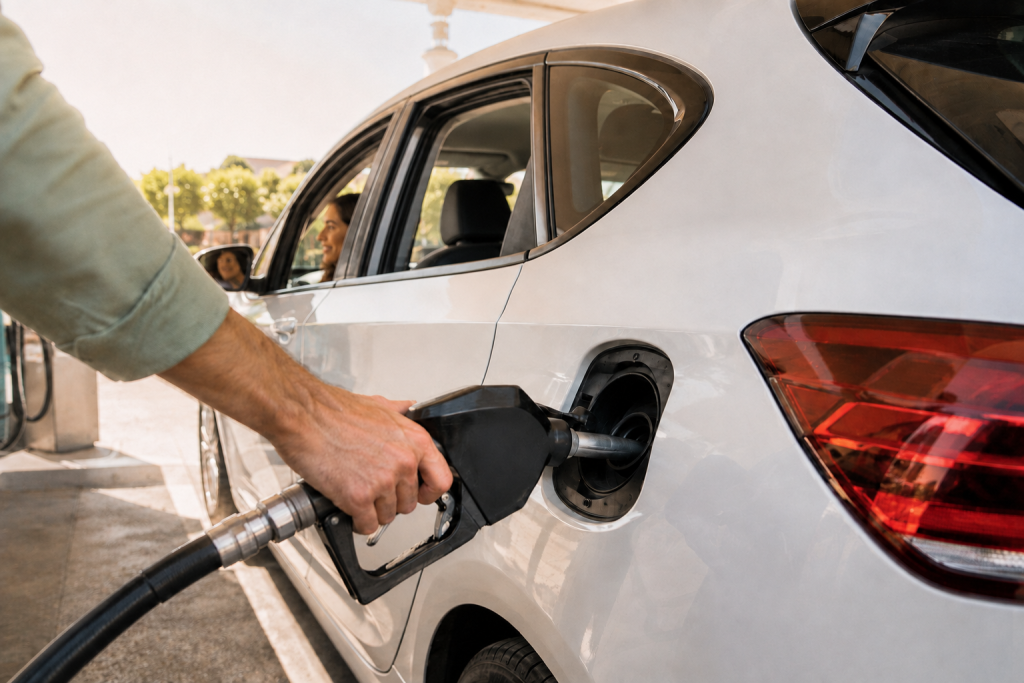
Car-sharing to get to work can cut an individual’s fuel costs for the journey by half or even two-thirds, depending on how many people travel together and the distance covered. On a typical 20 km round trip with two passengers in addition to the driver, fuel costs per person can fall from around €4–5 a day to less than €2. The exact amount depends on three factors: the car’s actual fuel consumption, the price of fuel that day and how many people split the cost.
At Waiis, we have prepared this article to explain how to calculate how much you can save by car-sharing, how to split the cost fairly between the driver and passengers, and which factors make actual savings vary from person to person.
How much can you save on fuel by car-sharing?
Car-sharing can save between 50% and 66% of daily fuel costs on commutes, as well as provide extra income if the energy savings from Energy Saving Certificates (CAE) are monetised. On a typical journey, the monthly cost of commuting alone can fall to less than a third when the costs are shared with other passengers.
Worked example: how much can you save on a 40 km daily commute?
Let’s take a typical commute as an example: 20 km each way (a 40 km round trip) to work, five days a week, in a car with average fuel consumption of 6 litres per 100 km. At an illustrative petrol price of €1.65 per litre (a guide price; the actual price varies by date and location, so check it before calculating your own journey), daily fuel costs would be:
– Journey consumption: 40 km × 6 L/100 km = 2.4 litres.
– Daily cost: 2.4 L × €1.65/L ≈ €3.96.
– Monthly cost (22 working days): ≈ €87.
If that person drives alone every day, they cover the full cost: about €87 a month on fuel alone. If they share the journey with two other passengers (three people in the car in total) and split the cost equally, each person pays about €29 a month, a saving of approximately 66% compared with travelling alone. With one additional passenger, the saving per person is around 50%.
These figures are an example, since actual savings depend on the vehicle’s specific fuel consumption, the price of fuel at the time and each person’s actual journey distance. However, estimated savings of between one-third and two-thirds compared with travelling alone remain broadly consistent for most typical commutes.
How do you split costs between the driver and passengers?
The most common and widely accepted fair approach is to divide the journey’s fuel cost by the total number of people in the car, including the driver. This means the driver pays their proportional share too; passengers do not cover 100% of the cost.
The basic formula is:
Journey cost ÷ number of occupants = cost per person
The journey cost is calculated as (distance in km ÷ 100) × the car’s average consumption (L/100 km) × the fuel price.
When costs are split manually (using a calculator, working it out in your head or making a bank transfer at the end of the week), it is common for friction to arise: someone forgets to pay their share, it is unclear whether only the outbound trip or the return journey is included, or whether someone who missed a particular day should be counted.
This is where an app such as Waiis makes things easier: the system automatically identifies people with compatible routines (similar times, origins and destinations) and manages the shared journey. It calculates and handles the cost split between the people who actually travelled that day directly in the app, so nobody has to keep track manually or rely on informal arrangements that can be forgotten over time.
Why choose Waiis to calculate and maximise your daily savings?
Although you can calculate how to split costs with a regular calculator, keeping track manually in your daily routine leads to oversights and friction. Waiis makes the process automatic, secure and much more cost-effective:
- Two sources of income for drivers: In addition to splitting fuel costs fairly, drivers can earn money from the Energy Saving Certificates (CAE). They can receive an additional €0.07/km, helping cover not only petrol but some vehicle maintenance costs too.
- Smart Match technology: The app intelligently analyses regular routes to automatically find people with compatible journeys and schedules, eliminating the need to coordinate trips manually every day.
- Guaranteed journeys with integrated alternatives: If there is no match with other users on a particular occasion, Waiis offers the option to book a taxi or private-hire vehicle at a fixed price, so you can always get to your workplace.
Automatic calculation and payment: The amount is calculated and handled directly through the platform, with no informal agreements or outstanding transfers.
Car-sharing compared with other ways to save on your commute
Compared with other ways to reduce commuting costs, car-sharing often offers a particularly favourable middle ground:
- Compared with driving alone, the saving is direct and proportional to the number of people sharing the journey, without changing your mode of transport or schedule.
- Compared with public transport, car-sharing can be more cost-effective on journeys where a pass or daily ticket is already expensive, or where public transport does not provide good door-to-door coverage and several modes would need to be combined.
- Compared with an occasional private-hire vehicle or taxi, the cost difference is much greater: a regular taxi or private-hire journey can cost several times more than an individual share of the fuel in a car-share, although this comparison does not include vehicle wear and tear or the availability of a fixed schedule.
Starting to save on your daily commute does not mean changing your habits or giving up the convenience of a private car. Automating the cost split and optimising regular routes can reduce your fuel bill month after month, while also contributing to smoother, more efficient urban mobility. With mobility technology such as the Waiis car-sharing app, organising a shared car journey becomes quick and straightforward, with transparent costs and hassle-free payments.
You might also be interested in

Is car sharing with Waiis safe?
Find out how safety works at Waiis: identity verification with Tecalis, driving-licence checks, a women-only option and real-time tracking.

Energy Bonus (CAE): What it is and how to claim it by car sharing
Discover what the Energy Bonus (CAE) is, how the Energy Savings Certificate system works and how to receive compensation for car sharing with Waiis.