
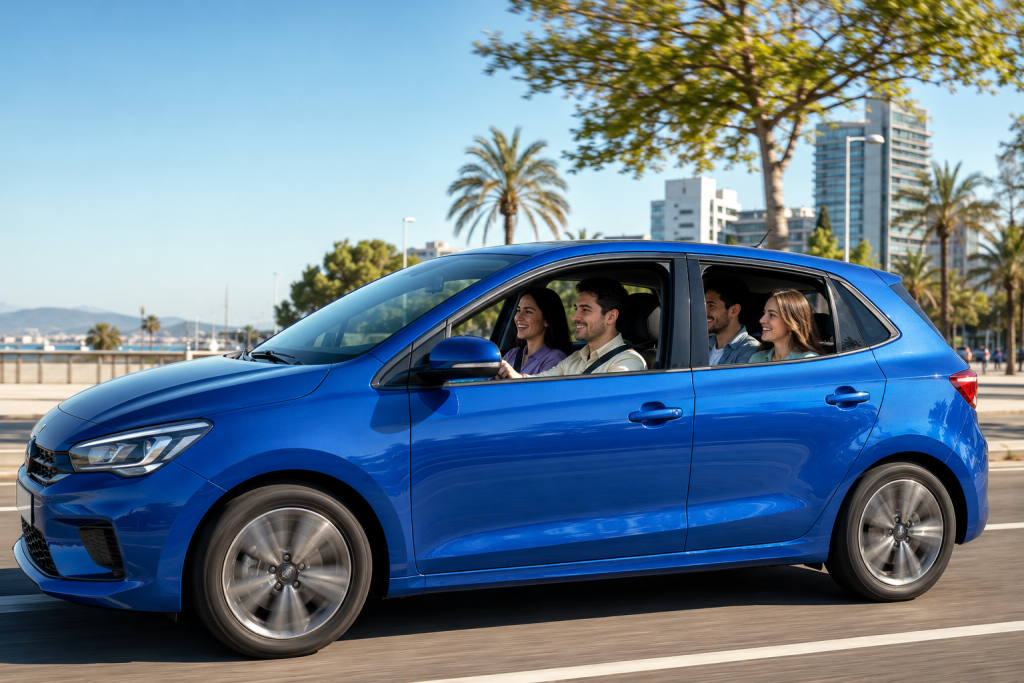
Need a car for a few hours, but do not want to buy one or take on all the costs of owning it? Carsharing offers a straightforward alternative: use a vehicle only when you need it and pay for the time or use you make of it.
In this article, Waiis explains what carsharing is, how it works, the different models available and how it differs from other options such as carpooling or car hire.
What is carsharing?
Carsharing is a vehicle-hire system where you pay for the time you use the vehicle, letting you use a car for minutes, hours or days without having to buy or own one. The service is usually managed through a platform or app, where users can locate, book and unlock a vehicle.
Unlike traditional car hire, carsharing is designed for using a vehicle for exactly as long as you need it, particularly for occasional or short trips.
How does carsharing work?
Although the process can vary from one platform to another, using a carsharing service usually involves these steps:
- Sign up in the app. Create an account and verify your identity and driving licence.
- Find a vehicle. The app shows cars available near you or within the service area.
- Book and unlock the car. Select the vehicle you want to use and unlock it, usually with your mobile phone.
- Use the vehicle. You can drive it for the period you have booked, and the cost is calculated according to the service’s terms and rates.
- Return the car. End your booking in line with the platform’s rules, which may require you to return it to a specific station, service area or parking space.
The main difference from traditional car hire is that the whole process is designed to be more flexible and digital, especially when you only need a vehicle for a short time.
What types of carsharing are there?
Not all carsharing services work in the same way. There are three main models:
Station-based carsharing
Vehicles are kept at designated stations or locations and must be returned in accordance with the service’s terms, usually to the same station or another approved station. This option is suitable when you know where your journey will start and end.
Free-floating carsharing
With this model, vehicles can be picked up and left within a designated service area, with no need to return them to the starting point. It is especially useful for urban journeys, as you can find an available vehicle near the place where you want to start your trip.
Peer-to-peer carsharing
Also known as peer-to-peer, this model lets private individuals make their own vehicles available to other users through a platform. There is not necessarily a fleet owned by a carsharing company; instead, individual users offer their vehicles for others to use.
How much does it cost to use a carsharing service?
The cost of carsharing depends on the platform, city, type of vehicle and length of use. You usually pay according to time, although some rates also charge per kilometre travelled. For example, some apps currently offer rates from €0.19 per minute, €8.99 per hour or €35.48 per day, although the final price can vary depending on the rate chosen, the distance travelled and other surcharges.
Before booking, it is therefore worth checking what the rate includes and whether there are any extra charges for mileage, parking, airport use or extending the booking.
Where is carsharing available in Spain?
Carsharing is particularly well established in large Spanish cities, where demand for urban journeys is higher and it is easier to keep a fleet available. Madrid and Barcelona account for a large share of the services, although operators are also available in other cities and availability varies by platform. Several operators currently serve the Spanish market, and the free-floating model is the most common.
Can you use a carsharing vehicle for several days?
Yes, although it depends on each platform’s terms. Carsharing is usually associated with use by the minute or hour, but some services let you book a vehicle for one or more days. Some platforms offer bookings from one minute up to 30 days, although the terms and rates depend on the service you choose.
If you need the vehicle for several days, it is worth comparing the total price with traditional car hire, which may be more competitive for longer periods.
What do you need to use carsharing?
Requirements vary between operators, but you will normally need to be an adult, hold a valid driving licence and register on the platform. During sign-up, the app will usually ask for documents to verify your identity and driving licence. Once your account has been approved, you can find and book available vehicles in the app.
It is also important to check the specific terms of each service, as there may be additional requirements relating to how long you have held your licence, the driver’s age or accepted payment methods.
Is carsharing cheaper than owning a car?
It can be if you only use a car occasionally, but there is no one-size-fits-all answer. The comparison mainly depends on how many miles you drive and how often you need a vehicle. With your own car, you have to cover fixed costs such as insurance, maintenance, tax, parking and depreciation, even when you are not using it. With carsharing, by contrast, you pay for the use you make of the vehicle, although the cost per journey may be less competitive if you use it every day or very frequently.
That is why carsharing tends to make most sense for people who only need a car occasionally and do not want to take on the costs of owning one.
Ultimately, carsharing is a flexible option for people who need to use a car occasionally without taking on the costs of owning a vehicle. Whether it suits you will depend on your needs, how often you use it and the options available in your city.
You might also be interested in
Carpooling: what it is, how it works and the benefits of sharing a car
Waiis explains what carpooling means, how it works, whether it is legal to charge passengers, its main benefits and why it is growing in Spain.

How much can you save by car-sharing and how do you calculate it?
Find out how much you can save by car-sharing. We explain how to split costs between passengers and how Waiis automates the calculation, payments and matching compatible journeys.