
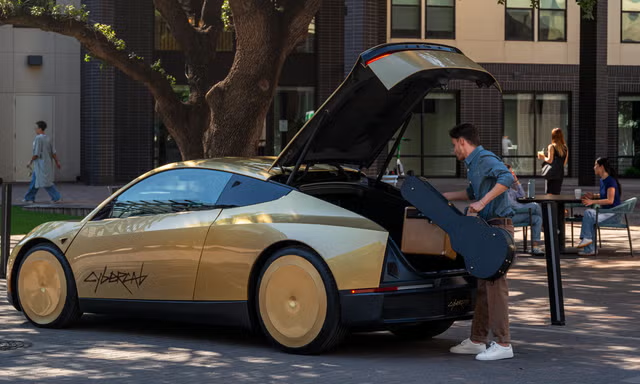
Ordering a car from an app and completing the journey without a human driver at the wheel is the experience robotaxis offer. These transport services use vehicles with automated driving systems and are already being developed in different cities around the world.
Their arrival is generating interest, but it also raises questions: how do they work? How much does a ride cost? When will they be available in Spain? And what effect could they have on traffic and urban mobility?
At WAIIS, we look at what robotaxis are and what you need to keep in mind to understand the role they could play in the mobility of the future.
What are robotaxis?
Robotaxis are passenger transport services that use vehicles capable of driving in an automated way, without human intervention during the journey, within the conditions they are designed and authorized for.
Unlike a conventional taxi, they don’t need a person to drive the vehicle during normal operation. However, this doesn’t mean they can drive in any city or on any road: their activity may be limited to certain areas and circumstances.
How does a robotaxi work?
Although the exact process depends on each operator, using a robotaxi usually involves these steps:
- Request a ride. The user opens the service’s app, enters their destination and checks whether the route is available.
- Confirm the pick-up. Once the request is accepted, the platform shows where to wait and provides information to identify the vehicle.
- Start the journey. The passenger gets into the robotaxi and follows the service’s instructions. Depending on the operator, they may also have options to request help during the trip.
- Analyze the surroundings and drive. The vehicle uses technologies such as cameras, radar, sensors and maps to detect other vehicles, pedestrians, signs and obstacles. With this information, its automated driving systems plan the route and handle driving within the conditions they are designed for.
- End the trip or handle an incident. When the vehicle reaches the destination, the journey ends. If a problem arises, it is important that the service has mechanisms for the passenger to contact the operator and receive assistance.
What is the difference between a robotaxi and an autonomous car?
Although some people may think so, a robotaxi and an autonomous car are not the same thing. A robotaxi refers to a transport service; an autonomous car refers to the vehicle and its ability to perform automated driving tasks.
An autonomous car can be used for testing or other purposes without carrying passengers through a booking service. To be considered a robotaxi, it must be part of a solution that allows people to request and make journeys.
This difference helps explain why advances in autonomous vehicles don’t automatically translate into new services available to the public. In addition to the technology, a defined operating model and the relevant permits are required.
How much does a robotaxi cost?
The price of a robotaxi depends on the city, the operator and the distance traveled. Although there are no confirmed commercial fares for Spain yet, prices in other markets offer some reference points.
In San Francisco, Tesla Robotaxi recorded a fare of $37.44 (around €32) for a 16-mile trip, approximately 26 kilometers, in July 2025, according to Not a Tesla App. Meanwhile, an analysis by Obi published in January 2026 put the median Tesla Robotaxi fare in the Bay Area at $7.39 over the period studied, from late November 2025 to early January 2026.
Separately, when Tesla unveiled its Cybercab in October 2024, Elon Musk announced that the vehicle would cost less than $30,000. This figure refers to the expected price of the vehicle, not of a ride.
In Spain, we will have to wait for operators to publish their fares to know the real cost. To determine whether these services are cheaper than a taxi or a ride-hailing service (VTC), equivalent journeys will need to be compared.
What is the difference between a robotaxi and a car with assisted driving?
The key lies in how much the vehicle can do by itself and whether it needs the driver to supervise. The assistance systems found in many of today’s cars can maintain speed, help with steering or brake in certain situations, but they don’t let you stop paying attention to the road.
To distinguish between these capabilities, the SAE classification sets out six levels of automation, from 0 to 5. Levels 1 and 2 correspond to assistance systems that require human supervision. At level 3, the system can take over driving under certain conditions, although it may ask the person to take back control.
Robotaxis are usually associated with level 4: the vehicle can perform all driving tasks within a defined operational domain without needing the passenger to act as a driver.
When will robotaxis arrive in Spain?
In September 2026, Spain’s Directorate-General for Traffic (DGT) authorized WeRide, Uber and AVOMO, the autonomous vehicle division of Moove Cars, to prepare the deployment of level 4 autonomous passenger vehicles.
The initial phase includes 20 vehicles and tasks such as street mapping, route validation and operational testing. The companies expect to begin commercial operations at the end of 2026, once preparations have been completed and the necessary requirements met. However, permission to test vehicles does not mean the service is already open to the public.
Where are robotaxis being tested in Spain?
The deployment announced by Uber, WeRide and AVOMO is initially focused on the Community of Madrid. The vehicles will be used to map streets, validate routes and test how the technology performs in real conditions. During this phase, they will have a specialist on board to supervise operations. That’s why these tests are not yet equivalent to a fully autonomous service that any passenger can book.
Are robotaxis safe?
Safety is one of the key factors in assessing whether robotaxis can be integrated into urban transport. These vehicles must interpret their surroundings, detect obstacles, recognize situations relevant to driving and make decisions within the conditions they are designed for.
However, having advanced technology does not in itself prove that a robotaxi is safer than a vehicle driven by a person. A rigorous comparison requires analyzing the available data, driving conditions, kilometers traveled and recorded incidents. It is also important to check how the system responds to unexpected situations, such as a closed street, roadworks, a change in signage or an emergency.
What are the advantages and disadvantages of robotaxis?
Robotaxis can expand transport options, although their usefulness will depend on where and how they are used.
Their potential advantages include:
- More transport alternatives: They can offer another option for certain journeys.
- Digital management: They allow users to request rides and check information through an app.
- Automated driving: Within their operational domain, the passenger doesn’t need to drive.
- Potential accessibility: They may make some journeys easier, provided the vehicle is adapted to users’ needs.
Their main challenges include:
- Limited coverage: They may only operate in specific areas and conditions.
- Incident management: They need effective mechanisms to respond to unexpected events.
- Operating costs: Technology and maintenance affect their economic viability.
- Urban integration: Pick-ups, stops and routes must be organized to avoid conflicts with other road uses.
How could robotaxis change urban mobility?
The impact of robotaxis will depend on which journeys they replace and how they are integrated with the rest of the transport system. Generating more individual journeys would not have the same effect as connecting neighborhoods with stations or complementing public transport.
The kilometers they travel without passengers while on their way to pick someone up, the space they take up and the energy they use must also be considered. A robotaxi being autonomous or electric does not in itself guarantee less traffic or lower emissions.
At WAIIS, we believe the future of urban mobility doesn’t depend on a single solution, but on combining alternatives that meet different needs. Robotaxis can expand transport options, while carpooling makes better use of the vehicles already on the road. The challenge will be to integrate these alternatives efficiently to make getting around easier and contribute to more sustainable mobility.
You might find this interesting

What will the cities of the future look like? Technology, mobility and sustainability
The cities of the future will be characterised by more people-centred urban planning, technological advances and new forms of mobility. Find out how travel patterns will change, what role car-sharing will play, and how to improve connections between neighbourhoods and local authorities.
How to reduce the cost of driving to work?: 6 practical tips
Commuting to work by car can be a significant monthly expense, what with petrol, parking and tolls. Find out how to work out the cost of your journeys and what steps you can take to save money